Election 2012: Campaigns, Coverage & the Internet

Posted by:
March 15, 2012 at 1:56 pm


A rockstar panel spoke at the AT&T Conference Center for South by Southwest Interactive on how social media is giving the presidential race a much needed makeover.

Claudia Milne with BBC, Micah Sifry with Personal Democracy Media,
Michael Scherer with Time Magazine, Teddy Goff and Zeynep Tufekci all gave compelling arguments for how candidates for the 2012 election are capitilizing on social media to spread their message and gain supporters.

Both Republicans and Democrats are both capitilizing on the amazing resources that lie at their fingertips.

The panel said that Facebook and Twitter are the most used means for social media, but Google + and the other plethora of sites out there can and should be used to gain the biggest advantage over competitors. Social media isn’t unique to the presidential race this year. Presidential candidates in 2008 began to take advantage of it, and since then every candidate that has any hope of being elected, from mayors to state senators and of course presidential candidates, better be Tweeting and sharing.

And it’s not just about the immediate contact from one campaign to potential supporters, but also the effect that a Tweet or share can have down the road. When Candidate X posts something on Facebook or Tweets it, media outlets can pick this up and if newsworthy, they might publish in print, online, on radio or t.v., which is priceless.

The room was overflowing with two dozen people sitting in the hallway outside the door to listen. Hopefully the politicians are taking this much interest in the topic or they might be left in the past because social media is the future of politicking.


How Not to Die: Using Tech in a Dictatorship

Posted by:
March 12, 2012 at 11:55 am


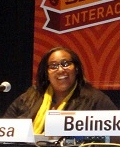
““We are about upgrading our humanity and our own freedom.” –  Mark Belinsky

Iphones, Twitter, Facebook and the like aren’t just for Americans wanting to talk about what bar to meet at or what celebrity said what anymore. Now this amazing technology has made its way into the hands of some of the most oppressed people on Earth. From  Burma to Tibet to Liberia and Egypt, citizens are using technology to rise up against oppressive regimes.

Brian Conley, Deanna Zandt, Mark Belinsky and Sabrina Hersi Issa talked about their unique experience with the ability of technology to aid in the democratic process around the world.

Belinksy, co-founder and president of Digital Democracy, explained how the ability of North Koreans to use USB flashdrives to watch politcal videos instead of having to use DVD’s has made it much easier to hide them from the authorities. This is very important when such acts could have you arrested. Belinksy called this the “right to be forgotten.”

Blinksy also used the term blowback to describe what happend when technology companies work with oppressive governments. Blowback is the unintended consequences of actions companies or governments take. He said that the “blowback was enormous” when Yahoo worked with the government in China and people got arrested for using yahoo email. Yahoo came under fire for doing this.

Even though technology does play a very powerful role in liberating people, it can’t do everything. “Technology is magic… but technology won’t solve our problems, we will solve our problems and technology will help us,” said Zandt, author and media technologist.

Hersi Issa talks about her experience with technology in oppressed countries and where she sees things going in the near future in the video below.


Super-sizing outcomes with supersized class

Posted by:
March 7, 2012 at 12:03 pm


John Boyer has a unique message: gigantic classes can build an environment with tremendous sense of communities and connection, engage students, and turn them into excited, lifelong learners. For three years, he’s been experimenting and perfecting the process. See preview here

John Boyer

John Boyer

He has help with that, including one specialist in instructional technology, Katie Pritchard, and 3 TAs. He says that the students provide a lot of help for one another too.

He stumbled into teaching a super-sized class when his course in World Geography at Virginia Tech had a waiting list of 4700 students even though he taught in the largest classroom available with all 580 seats filled. He thought it would be just for one year while he cleared out the backlog. But he continued to have nearly 3000 sign up each year.

How does it work? With a lot of flexibility, including in what students do for their grades. They could take a number of multiple-choice tests, research and write or produce a video or other project, or any of a number of other options or combination of options. Continue reading “Super-sizing outcomes with supersized class” »


Prepping for SXSW with Indiana University Students

Posted by:
February 27, 2012 at 4:01 pm


This will be the third year that Dr. Hans Ibold (@hanspi) has traveled to SXSW Interactive with a group of students from Indiana University. In helping them prep for the event, I spent a little time on Skype providing some advice. They had some great questions and observations. I look forward to meeting them all in person at SXSW!


Preview – “Social Media in Colombia: An Agent for Change”

Posted by:
February 11, 2012 at 2:18 pm


The role of social media has played an integral part all around the world, including Colombia. Partly due to drug trafficking, Columbia has been in a state of armed conflict since the 60’s, but since the 80’s the violence from drug trafficking has become much worse. In “Social Media in Colombia: An Agent for Change,” Colombia’s former Minister of Telecommunications, Daniel Medina, along with Andrés Traslaviña MS Ed,  will discuss how social media has “empowered the people to join the war against drug trafficking,” according to the panel.

Traslaviña’s mother was an undercover prosecutor in Columbia during the drug war during the 1990′s – this was part of his inspiration for being a part of the panel. He witnessed first hand the problems his nation faced.

“Colombia´s political realm has positively changed as a result of people having access to information not previously available to them,” said Traslaviña.

He said that what happened in Columbia is an example of how a country can go from being one of “the most feared” nations to one of the most peaceful nations. He described the current situation of Mexico to what was happening in Columbia.

Traslaviña hopes people will see that “in the same way Social Media helped Colombia is a way to empower people to make change happen.”  Traslaviña  believes that access to social media  ”in marginalized regions will improve the well-being of people.”

Medina Traslaviña  will provide compelling examples of activism with the use of technology and social media. The panel starts at 9:30 am on Saturday, March 10th and will last an hour, located at the Austin Convention Center.


Slider by webdesign